
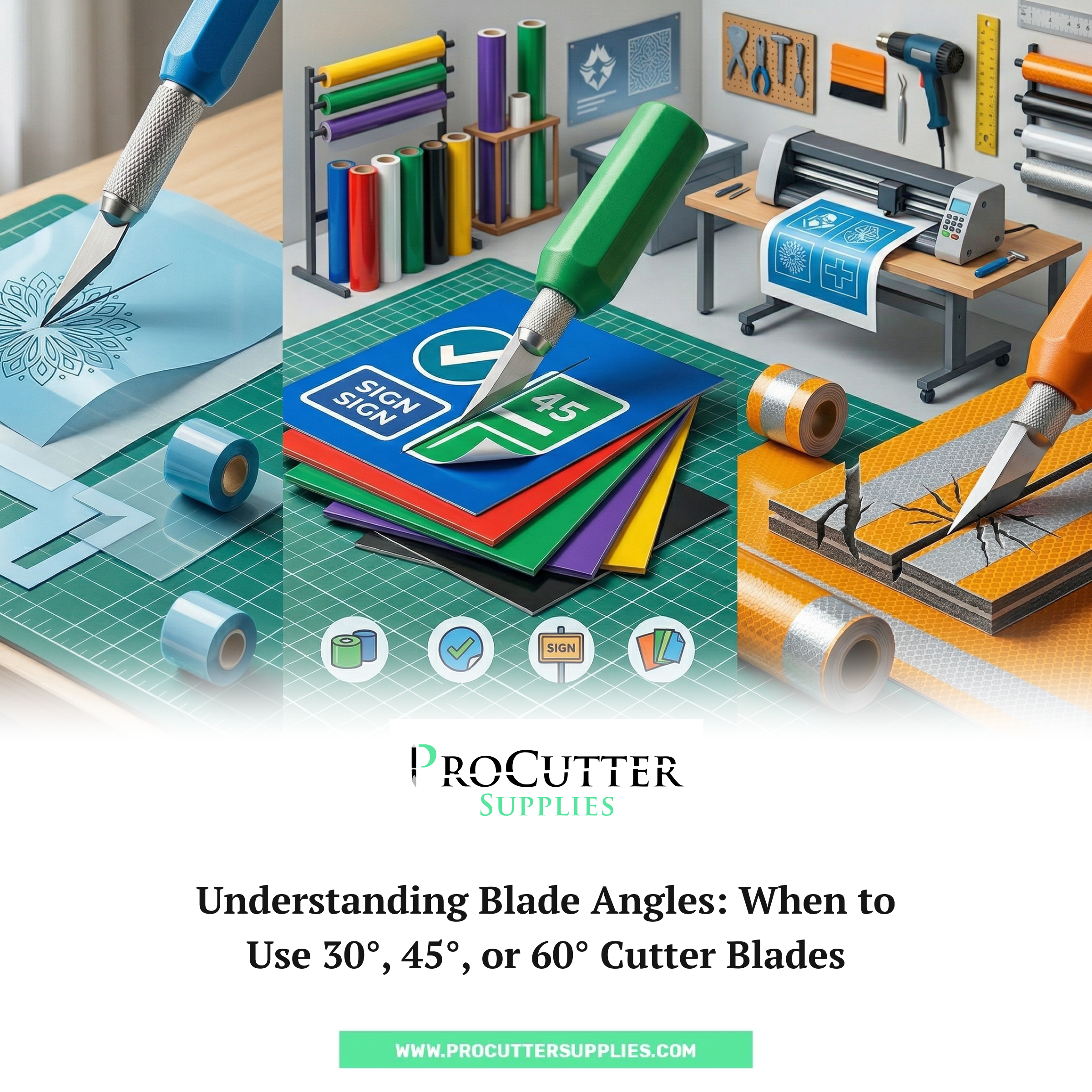
If you’ve ever looked at different cutter blades and wondered why there are multiple angle options, you’re not alone. At first glance, a blade is just a blade. But once you start working with different materials and designs, the angle becomes much more important than it seems.
Choosing the right blade angle isn’t about preference; it’s about how the blade interacts with the material.
Using the wrong one won’t necessarily stop the machine from cutting, but it can affect edge quality, detail, and even how long the blade lasts.
What Blade Angle Actually Means
The angle of a blade refers to the shape of its tip. A lower angle creates a shallower edge, while a higher angle produces a sharper, more pointed tip.
That shape determines how the blade enters and moves through the material.
A shallow angle glides more easily through thin materials, while a steeper angle is better suited for thicker or tougher surfaces.
Understanding this difference helps you choose the right blade for each type of job instead of relying on trial and error.
30° Blades: Best for Thin, Delicate Materials
A 30-degree blade has a relatively shallow angle, which makes it ideal for thin materials where precision matters more than cutting force.
These blades are commonly used for lightweight vinyl, window tint, and very fine detail work.
Because the tip is less aggressive, it produces smooth, clean cuts without digging too deep into the material. This reduces the risk of tearing or lifting, especially on delicate designs.
However, 30° blades aren’t designed for thicker materials. Using them on heavy vinyl or laminated surfaces will wear them down quickly.
45° Blades: The Everyday Standard
If there’s one blade that most operators keep loaded by default, it’s the 45-degree blade.
It sits right in the middle, not too shallow, not too steep, which makes it suitable for a wide range of materials. Standard sign vinyl, decals, and general-purpose cutting jobs are all well within its range.
For many users, this is the blade that handles the majority of their daily work.
Because of its versatility, it’s often the starting point when setting up a new job. If the material doesn’t require anything specific, a 45° blade usually gets the job done without any issues.
You can find reliable options for different blade angles here:
https://procuttersupplies.com/collections/summa-cutter-blades
60° Blades: For Thick or Challenging Materials
A 60-degree blade has a much sharper angle, which allows it to penetrate thicker materials more effectively.
These blades are typically used for heavy vinyl, reflective materials, sandblast films, or laminated graphics.
Because the tip is sharper, it can handle more resistance without dragging. However, that also means it’s more delicate. The fine tip can wear faster if used on materials that don’t require that level of sharpness.
For that reason, 60° blades are best reserved for specific jobs rather than everyday use.
Why Using the Wrong Angle Causes Problems
Using the wrong blade angle doesn’t always lead to immediate failure, but it often shows up in subtle ways.
A shallow blade used on thick material may struggle to cut cleanly, leading to incomplete cuts or rough edges. On the other hand, a steep blade used on thin vinyl may dig too deep, affecting both the material and the cutting strip.
Over time, these mismatches increase wear and reduce consistency.
Matching the blade angle to the material helps maintain both cutting quality and blade life.
Switching Blades Based on the Job
Many experienced operators don’t rely on a single blade for everything. Instead, they switch blades depending on what they’re cutting.
It might seem like extra effort at first, but it quickly becomes part of the workflow.
Keeping a few different blade angles on hand allows you to handle a wider range of materials without compromising quality.
Suppliers like Pro Cutter Supplies make it easy to keep multiple blade options available:
https://procuttersupplies.com/
Final Thoughts
Blade angles aren’t just a technical detail; they directly affect how your cutter performs.
Once you start matching the blade to the material, you’ll notice cleaner cuts, easier weeding, and fewer adjustments during jobs.
A 30° blade works best for fine, delicate work. A 45° blade covers most everyday tasks. And a 60° blade handles thicker, more demanding materials.
Having all three available gives you flexibility and helps your Summa cutter perform at its best, no matter what you’re working on.